
IN THE NEWS
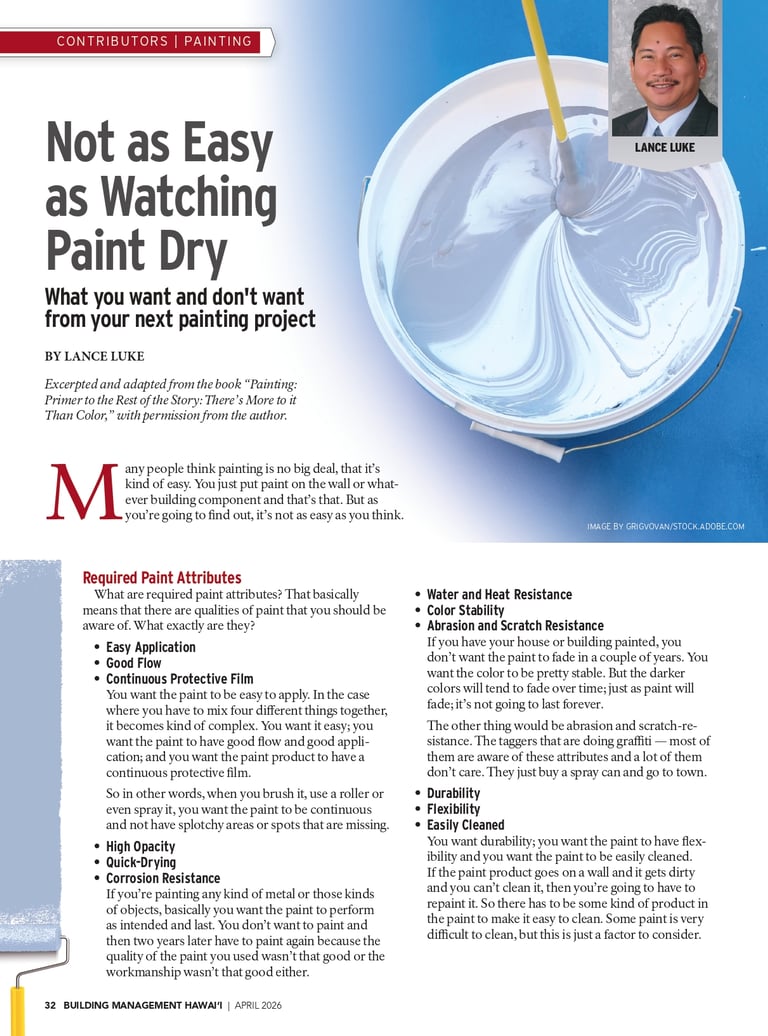
Expert Insight: Lance Luke Featured in Building Management Hawai'i (BMH)
"I am pleased to share my latest technical feature from the April 2026 issue of Building Management Hawai'i (BMH). While many think painting is a simple cosmetic task, it is actually a critical component of building envelope integrity. In this article, I discuss the mechanical and chemical attributes required for a professional-grade project—insights excerpted from my book, Painting: Primer to the Rest of the Story."



Weather
Lost Homes, Destroyed Farms: Hawaiʻi Takes Stock In Wake Of Storm
The storm brought flash floods and damaging winds to all parts of the state between Thursday and Sunday, but no deaths and only two serious injuries were reported.
By Madeleine Valera, Caitlin Thompson, Kevin Dayton / March 16, 2026
Carrie Bashaw watched from her Maui home as the ʻĪao Stream, strengthened by torrential rains from the storm that swept across the state over the weekend, gobbled up two trees — a 30-foot mango and a gigantic monkeypod.
“They went floating down the river, and we said, ‘OK, that’s not a good sign,’” she said.
Over the next four hours, the raging water continued to rise, eating about 100 feet of Bashaw’s property on Mokuhau Road, until it reached her doorstep.
Carrie Bashaw watched from her Maui home as the ʻĪao Stream, strengthened by torrential rains from the storm that swept across the state over the weekend, gobbled up two trees — a 30-foot mango and a gigantic monkeypod.
“They went floating down the river, and we said, ‘OK, that’s not a good sign,’” she said.
Over the next four hours, the raging water continued to rise, eating about 100 feet of Bashaw’s property on Mokuhau Road, until it reached her doorstep.
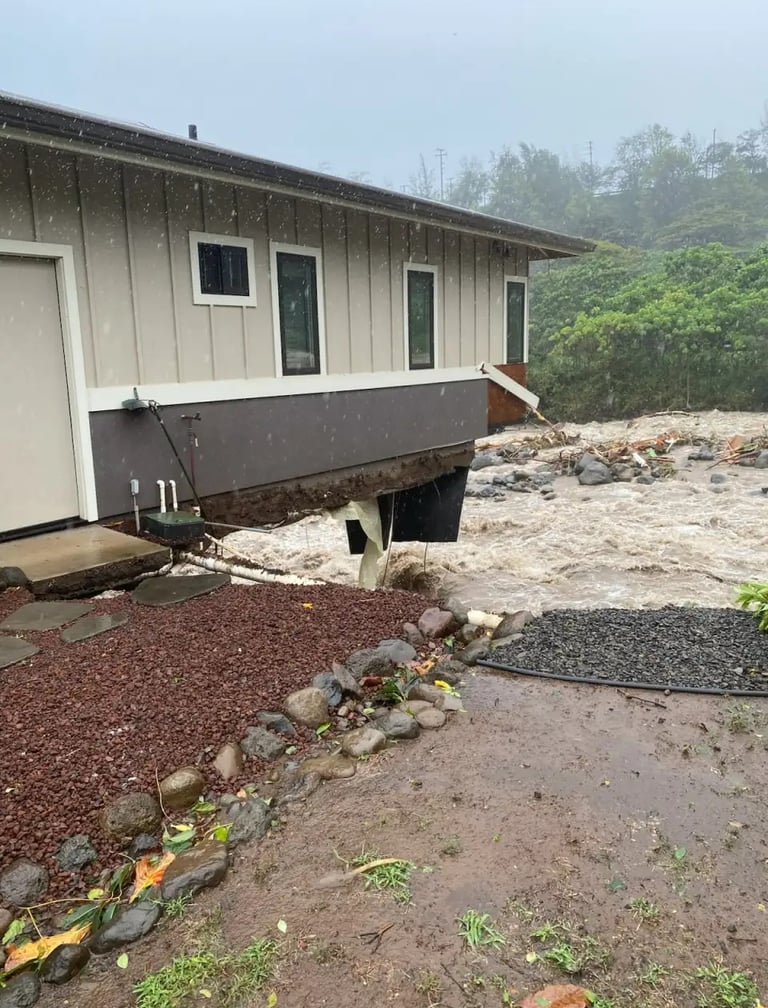
Rising waters from the ʻĪao Stream eroded the ground beneath Carrie Bashaw’s Maui home, causing it to fall into the stream and get swept away. (Courtesy Carrie Bashaw)
At that point, Bashaw, her husband Tom, and their two cats, Civa and Ty, were packed and ready to go.
“As soon as the front entry… tiles started to crack, we said, ‘OK, we can’t salvage anything else,’” she said. “‘Let’s just get the hell out of here.’”
The couple fled to a barn about 180 feet back from the stream. By morning, water had eroded the ground out from under the home where the Bashaws had hoped to spend their retirement, and swept it away.
“I was going to have my grandkids come over for the summer,” she said. “But I texted my daughter, I said, ‘I think maybe I’ll come visit you instead.’”
As state buildings prepared to reopen Monday and residents started to dry off from the weekend’s deluge, officials began taking stock of the Kona low’s toll. Cleanup crews had already begun work Sunday repairing roadways, clearing debris and siphoning trash out of Waikīkī’s Ala Wai Canal. District courts in Kāneʻohe and Wahiawā on Oʻahu will be closed Monday for cleanup after water made its way into both courthouses over the weekend.
At the storm’s peak, more than 100,000 Hawaiian Electric customers were without power and by Sunday afternoon, more than 32,000 were still without electricity. The company put out a statement saying that 300 crew members were in the field doing repairs. The H-3 Freeway at the Helkou Interchange in Kāneʻohe was closed Sunday afternoon to allow for some that work.
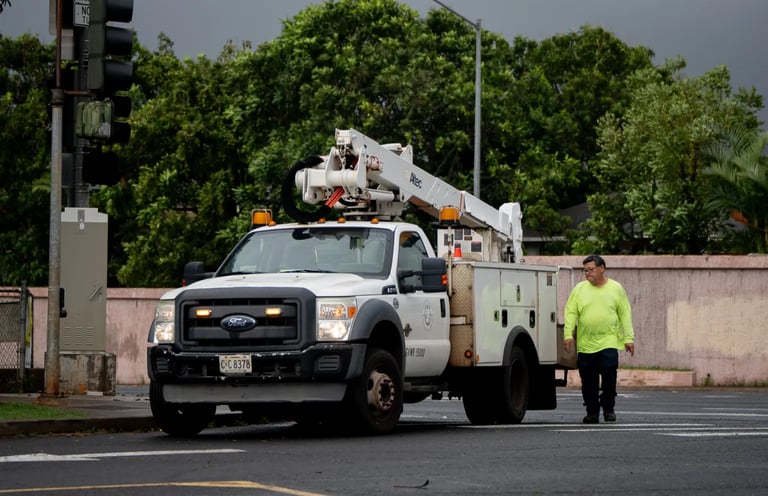
At the storm’s peak, more than 100,000 Hawaiian Electric customers were without power. As crews fanned out, by Sunday that number was down to 32,000. (Craig Fujii/Civil Beat/2026)
As official rain gauges rose, it became increasingly clear that the subtropical cyclone that tore through the Hawaiian islands between Thursday and Sunday was no ordinary storm.
It broke rainfall records, flooded roads, tore off roofs, uprooted trees and threatened to compromise the Wahiawā Dam, forcing residents of Haleʻiwa and Waialua to spend most of Friday night monitoring evacuation warnings. Their evacuation notice was lifted early Saturday.
Gov. Josh Green on Sunday said the state was beginning to assess the damage. But no deaths were reported, the governor said, and only two people were seriously injured.
“Overall, people responded very well,” Green said.
Many residents watched the storm play out on social media, including via Hungry Hungry Hawaiian Newz, an Instagram account that collects videos from community members and shares them to more than 300,000 followers.
A bulldozer helped clear a landslide on Hulemalu Road on Kauaʻi Friday. (County of Kaua‘i/2026)
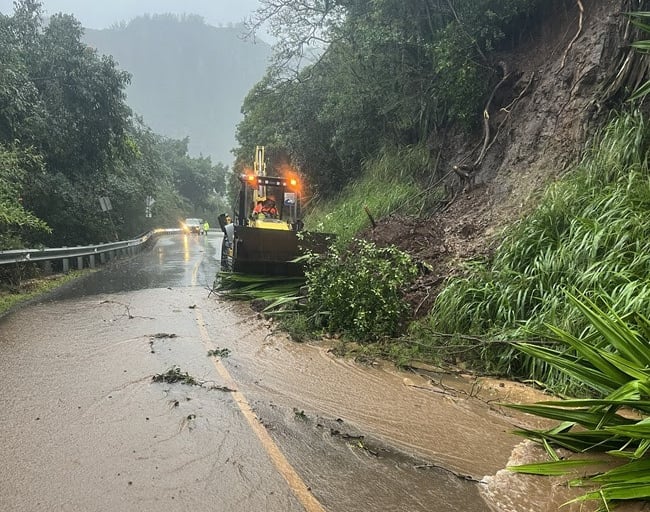
Dramatic scenes unfolded across the islands. Rocks tumbled from a hillside in Pālolo on Oʻahu. The entire roof was ripped off a popular bar and restaurant in Kona on the Big Island. On Kauaʻi, the parking lot at Poʻipū Beach was flooded with brown water. Sinkholes opened up on some Maui roads, including on South Kīhei Road, where a white van had fallen sideways onto an eroded beach.
Videos also showed people out in the stormy weather, defying officials’ pleas to stay home. Some boogie-boarded on turbulent brown water rushing down flooded roads, while others surfed and kite-boarded in menacing waves.
The force of the downpour varied from town to town, soaking some areas that typically are drier. Meteorologist Kenki Kino with the National Weather Service said the most damaging rainfall fell in South Maui, which endured up to 16 inches.
“A lot of those places only average 10 to 15 inches a year,” he said. “So they got their average annual rainfall and then more with this one storm.”
Statistics told their own story of the storm’s power. In Honolulu, the amount of rainfall in February and the first half of March hasn’t been this high since at least 2000, totaling at least 12.25 inches. The previous high set in 2017 was roughly two inches less. Friday was the single rainiest day in the state’s capital in more than two decades, with 5.51 inches of rain.
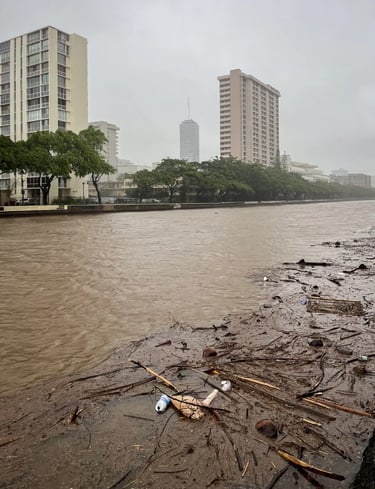
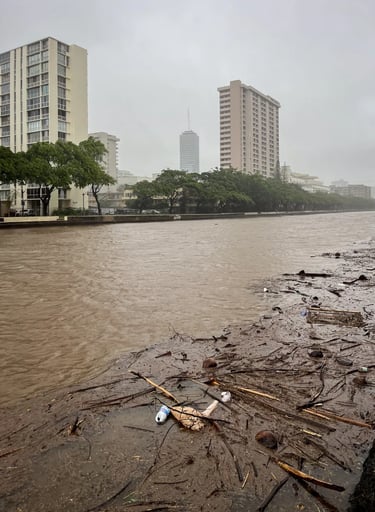
Debris gathered on the Waikīkī side of the Ala Wai Canal on Friday. Crews on Sunday were working to clean up the canal. (Craig Fujii/Civil Beat/2026)
On Kauaʻi, Līhuʻe hasn’t had a wetter year in more than a decade. At least 14.85 inches of rain have fallen there since the start of February. Friday was the city’s rainiest day so far this year, with a total of 5.47 inches.
As the Kona low rolled east and dissipated in some parts of the state, the Big Island and Maui continued to feel its impacts. Already, as of Saturday, Hilo had recorded more than 26 inches of rain since the start of February. The National Weather Service logged more than 5 inches of rain in just three hours that evening near the Puʻuhonua o Hōnaunau National Historical Park south of Kailua-Kona.
On Maui, the Kula Forest Reserve had been pummeled by more than 6.5 inches of rain in a three-hour period ending early Saturday morning.
“I believe that it’s getting worse,” said Dominic Kadooka, who owns Waimānalo Country Farms with his wife, Shawn.
On Kadooka’s property the storm tore down trees, flooded fields, stripped roofs off of barns and toppled shacks, chairs and tables. It was the most severe damage he’s seen there since family members founded the farm in 1948, Kadooka said.
“This wind we had yesterday,” he said Saturday, “it’s the most powerful that I’ve seen.”
Addressing Extensive Damage
While the state began its work to estimate the scope of the damage, it was already clear that public infrastructure, private homes and many kinds of services across the islands had been significantly affected.
Crews on Oʻahu were working Sunday to repair damaged storm drain culverts on the Pali Highway and Kionaole Road in Kāneʻohe. A rockfall catchment fence on the mauka side of Kamehameha Highway in Waipiʻo was damaged when it caught multiple large boulders late Friday.
The Maui Department of Environmental Management temporarily suspended trash pickup to some residents on the eastern part of the island due to a landslide blocking access on Kamehameha V Highway near Kawela Gulch. Service was expected to resume Thursday.
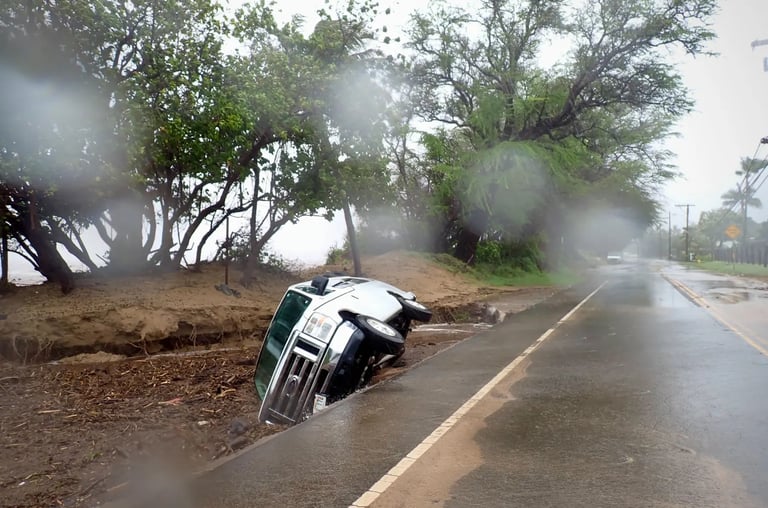
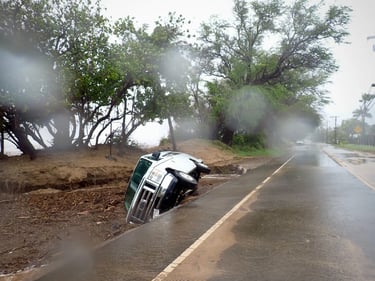
A van on South Kīhei Road on Maui fell into a sinkhole on Saturday. The storm damaged infrastructure and disrupted public services across the state. (Erin Nolan/Civil Beat/2026)
The Kula Hospital in Upcountry Maui closed its emergency department on Saturday evening because of the severe weather and referred anyone seeking care to Maui Memorial Medical Center, 20 miles northwest in Wailuku.
Lance Luke, a Hawai‘i forensic construction engineer, put out a news release advising homeowners to document damage carefully to report it to their insurance companies. He outlined the steps they should take: walk around their homes, take pictures and videos of any damage they see and keep an eye out for fallen debris, standing water near the foundation, clogged and overflowing gutters, stucco cracks and rust stains.
Each can offer clues to hidden problems, Luke told Civil Beat. Standing water around the home, for instance, could indicate the foundation has been damaged.
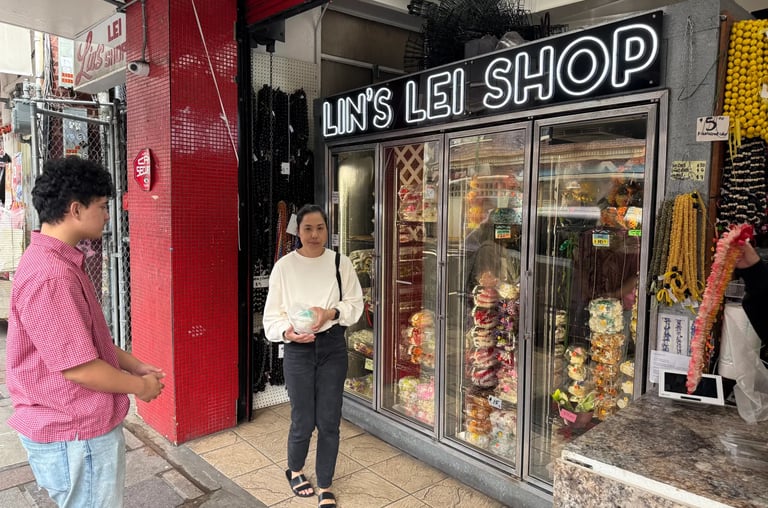

Nanette Naboa picks up a lei for her daughter, who was competing in a dance competition at Hawaiʻi Theater Center. While many events were canceled, the competition was expected to proceed as planned. (Madeleine Valera/Civil Beat/2026)
The storm had ripple effects for businesses, too, some of which were wind-whipped, flooded or coping with no-shows and cancellations.
Hinaleimoana Wong-Kalu, a cultural ambassador with the Hawaiian Council, was worried about the financial impact on lei makers who had already strung garlands for events that were canceled, including the annual Kamehameha Schools Song Contest, which had been scheduled for Friday evening.
She sent out a public plea for participants to follow through and still pick up and pay for the lei they had ordered.
But Alex Nguyen, a manager at Lin’s Lei Shop in Chinatown, said most customers canceled their orders, and, if they paid in advance, Lin issued refunds. The shop had made hundreds of lei, ranging in price from $8 to $60, with purple, green, pink and red flowers to reflect the students’ class colors.
The contest is one of the biggest events of the year for the shop, he said, and he expected to lose tens of thousands of dollars because of its cancellation.
Homeless Particularly Vulnerable
Among those who faced the most physical danger were the state’s homeless, who often live along riverbanks and on beaches, under bridges and low-lying freeway overpasses.
Honolulu firefighters rescued four people who had been living under a bridge near Kaimukī High School and became trapped as the Mānoa-Palolo Stream rose Thursday morning.
Rescuers in red helmets and lifejackets clambered down the muddy banks and climbed down a ladder to reach the two women and two men stranded below. They tethered the people with ropes for safety, then helped them up the ladder. Their dog, too, was hoisted up.
Everyone was OK, but the group declined an offer of shelter from the city’s CORE team, a division of emergency services that focuses on homeless individuals.
By nightfall on Thursday, the team had also relocated eight people living on Westside beaches to the U.S.VETS shelter in Waiʻanae. Dozens of emergency shelters were opened up by counties, and many of the hundreds who used those facilities were homeless.
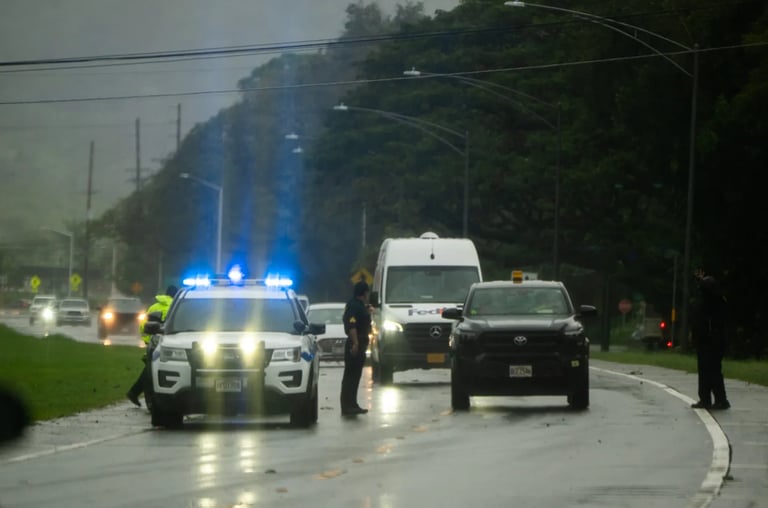
Honolulu Police closed a section of Kahekili Hwy at ‘Ahuimanu on Friday. A slow-moving Kona storm dropped dramatic amounts of rain across the state. (Craig Fujii/Civil Beat/2026)
At the Puʻueo Community Center shelter in Hilo on Saturday morning, a half dozen men and women were gathered around a table as sporadic rain fell outside, eating snacks and occasionally singing along with island music playing in the background.
When asked if they were homeless, all nodded. Among them was Tina Whitney, 61, and her sister Roberta. Whitney said she has been living on the street or in her car for about six weeks, after her money ran out and she couldn’t make rent. Then her car died, she said, and “I’m working on getting … a car again because I cannot stay like this.”
Across Hawaiʻi County, a dozen emergency shelters were housing 43 people as of Saturday morning. county spokesman Tom Callis said all but two were homeless.
A deluge closed roads in North and South Kona, Kohala, Puna and Kaʻū on Saturday evening, and Hawaiʻi County Assistant Fire Chief of Operations Christopher Olai Carvalho said fire crews scrambled for hours answering calls for help from residents stranded in their homes and cars.
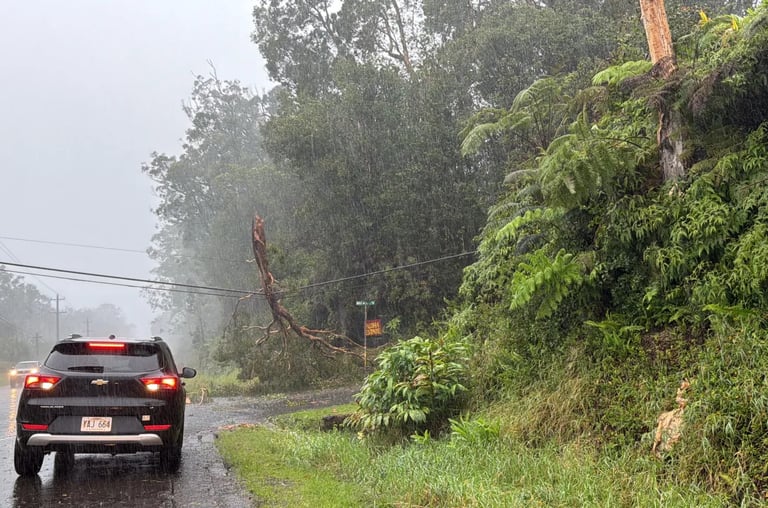
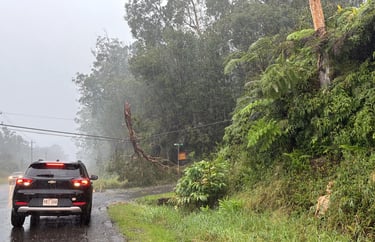
A tree branch fell on a power line in Volcano near the Aloha Estates Subdivision on the Big Island. (Taylor Nāhulukeaokalani Cozloff/Civil Beat/2026)
Water rushing across the Māmalahoa Highway in the Konawaena area reached heights of 4 to 6 feet shortly after 7 p.m., he said, and fire and rescue crews were deployed for rescues on both sides of the surging water at Konawaena Road.
“At that point we had homes, we had some vehicles that were trapped with people trying to cross moving water and got stuck,” Carvalho said. “Calls were just dropping.”
Parts of Captain Cook and Nāʻālehu in Ka’u became isolated, and one road after another became impassable. Carvalho said the county called for Hawaiʻi National Guard LMTVs or Light Medium Tactical Vehicles to help with the rescues because they were better suited than fire trucks to cross the deep, rushing water.
One of those vehicles also helped move about a half-dozen evacuees from an emergency shelter at Nāʻālehu Community Center to another shelter at Nāʻālehu Elementary School after water in the area’s flood canal rose.
The rain finally began to let up at about midnight Saturday.
Hurricane-Strength Winds
Damaging wind gusts were a hallmark of the Kona low storm, threatening property and people.
At Makapuʻu Beach on Oʻahu, 81-mph wind gusts were recorded on Friday. Kāneʻohe Bay experienced 70-mph gusts.
Winds came even harder in Kula on Maui Friday night, up to 108 mph, and early Saturday morning gusts of 79 mph were recorded at the Kona airport.
Big Island Mayor Kimo Alameda said the storm was the most damaging he has seen since he took office in 2024, with Kaʻū and the leeward Kona side of the island hardest hit.
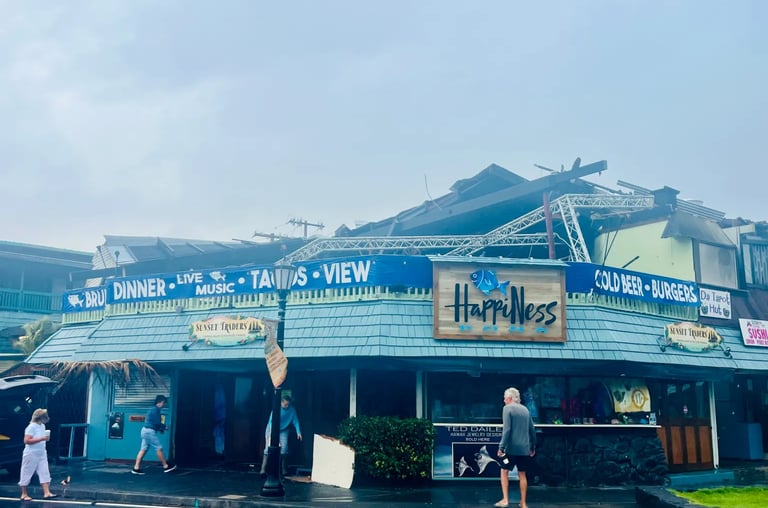
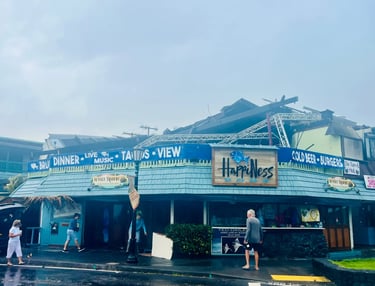
Powerful and unpredictable winds from the storm caused extensive damage to two businesses on Aliʻi Drive in Kailua-Kona over the weekend. (Courtesy Hawaiʻi County)
Powerful gusts partially ripped the roofs off two Aliʻi Drive businesses in Kailua-Kona late Friday night, and a fallen tree on Highway 190 in North Kona caused a motorcycle crash at about 5 a.m. Saturday, county officials said. Alameda said the motorcyclist was flown to an Oʻahu hospital for treatment.
A downed tree in North Kona also caused major damage to two houses, the mayor said, but there were no other reports of injuries.
“The winds are killing us on the west side,” Alameda said Saturday afternoon. “It’s like 30 miles an hour, and then all of a sudden it’s 70. That’s all you need, is a big gust.”
Reporters Erin Nolan, Noelle Fujii-Oride and Taylor Nāhulukeaokalani Cozloff contributed to this report.


Waikiki hotel incident raises railing safety concerns
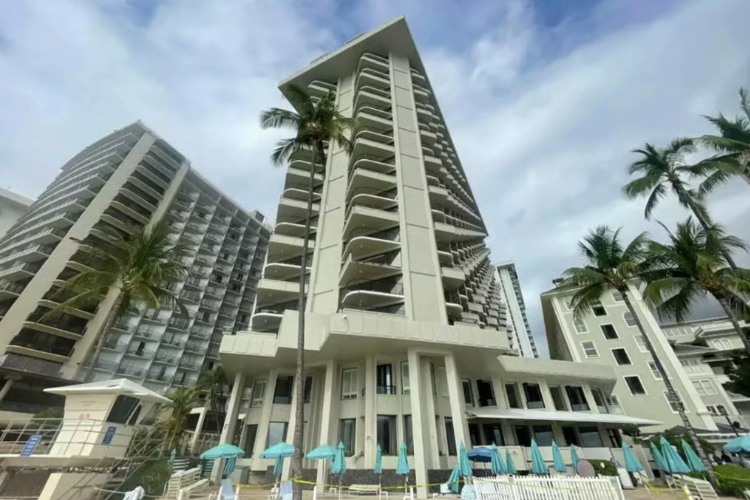
HONOLULU (KHON2) — A frightening situation in Waikiki Tuesday afternoon after a 5th floor balcony railing at the Moana Surfrider Hotel came crashing down onto the beach.
Luckily, no one was on the balcony when it happened and no one was seriously hurt below, but it’s raising concerns. A building expert said it may be a much larger probl|em.
| ‘It was happening in slow motion,’ Waikiki railing falls off balcony |
National building expert Lance Luke was at the scene Tuesday afternoon and said it’s unsettling because it’s likely a much bigger problem.
“I think water is getting through on the top tile and penetrating to the concrete because that leaning edge which is ahead of the balcony, I could see horizontal rebar that was pretty corroded,” Luke explained. “I’m pretty sure that this is not the only unit like that. I think it’s a global thing. I’m looking the whole building.”
“Knowing that it fell without even any pressure being applied to it. What does that mean really?” KHON asked.
“That’s even scarier,” Lance replied. “Because no human forces are pushing the railing and it just collapses on its own. That means that the anchor points of that wall connected to the lanai slab is very weak. All those hotel units that have similar walls– and I’m like all those–could come down too.”
He said serious action needs to be taken. All the guests need to be notified and the hotel needs to block off the balconies until they’re inspected and deemed structurally sound.
“Not just putting caution tape, but maybe 2 X 4 and make a little structure. So no one can even go close to the railing,” he said.
In a statement, the City’s department of planning and permitting said:
The maintenance of private high-rise buildings is the responsibility of the building’s owner or management firm. However, if we become aware that a building may be unsafe, we will send an inspector to investigate. If we determine that a building is unsafe, the Building Code allows the DPP to take immediate action to protect the health and safety of the building’s residents. We may also ask the owner or management firm to provide a structural assessment report of the building for our review.
“DPP could theoretically come down and shut the hotel down,” Luke said.
Doing the necessary inspections could take a long time and fixing any structural issues would be extremely expensive.
“It’s going to be millions of dollars to repair. I can tell already but it needs to be done.”
by: Jenn Boneza
Posted: Jan 30, 2024 / 08:55 PM HST | Updated: Feb 1, 2024 / 09:11 AM HST
Link to the source article: Waikiki hotel incident raises railing safety concern



Waikiki railing collapse likely a bigger problem for hotel
Building expert says the rusting of the railing probably started five to eight years ago.
HONOLULU (Island News) -- We have a follow up on yesterday's hotel-railing collapse from a fifth-floor hotel room at the Moana Surfrider. Amazingly, it did not fall on anyone, but debris hit a couple people nearby causing minor injuries, according to Emergency Medical Services and the Honolulu Fire Department.
An expert in building safety tells Island News this is probably just one symptom of a much larger problem for the hotel.
Lance Luke, owner of Construction Management Inspection, says, "I'm kind of used to seeing these kind of situations. In my opinion, it's not an isolated situation with only that one [railing]. It's probably a condition at all the other units in the hotel which should be investigated and checked."
Luke says this probably started rusting five to eight years ago.
"I'm pretty sure the attachment of the metal anchors corroded and causes the wall to fall down," he guesses, adding that it's good policy for any building with railings to have them professionally checked on a regular basis.
Luke thinks this hotel now needs to test all the railings - an expensive endeavor. He estimates the cost to replace just one railing is $20,000 to $30,000.
"It's not structurally sound and I'm pretty sure the other railings in that building have similar conditions," he says.
The City and County of Honolulu's Department of Planning and Permitting on Wednesday says it's working with Kyo-Ya Hotels & Resorts, and will send an inspector out to the Moana Surfrider.
On Wednesday, it said, "The maintenance of private high-rise buildings is the responsibility of the building's owner or management firm. However, if we become aware that a building may be unsafe, we will send an inspector to investigate. If we determine a building is unsafe, the Building Code allows the DPP to take immediate action to protect the health and safety of the building's residents."
Kyo-Ya said after the incident on Tuesday, "We are looking into an incident that occurred involving a balcony in our tower wing. We take this matter very seriously. The safety and security of our guests and employees is our top priority." It did not respond to a request for an update on Wednesday.
Luke says he never would have known by just looking at it - if the rail hadn't fallen - that there was a structural issue. His advice to anyone standing by a railing is to be on the safe side and don't lean on it.
In the meantime, this has become a story picked up by some media across the country including Forbes and TV stations in Alabama and Mississippi.
It's a little scary for these visitors from Minnesota who we met on the beach near the scene. Cathy Arriola and Lisa Argir decided, after seeing this, to not lean on their hotel railing when they return to their rooms.
They have been keeping up with the local news on their vacation and after this, plus Tuesday's barricade at Waikiki Sunset Hotel and last Tuesday's acid injury, the women are a little concerned.
"You don't want this becoming the norm. It may make people question if this is a place to go to that's safe," Argir cautions.
Arriola says if these three events happened before she booked the vacation here, "I'd have to think about" wanting to come to Hawaii.
Hawai'i Lodging & Tourism Association president and CEO Mufi Hannemann says, "The safety of our guests, local residents, and hotel associates is our visitor industry's number one priority. We encourage and know that our HLTA hotel owners, operators, and managers are vigilant in implementing necessary protocols to address any potential incidents.
"Hawai'i has long held an exemplary reputation as a safe destination, and we want to maintain that. We are confident that our hotel members consistently prioritize the assessment of their structures' safety.
"We feel fortunate that no injuries occurred during the recent incident, and we are aware that the hotel is promptly taking action to address the situation."
Island News was not able to reach Hawaii Tourism Authority for comment on this on Wednesday.
By: Diane Ako
Jan 31, 2024 Updated Jan 31, 2024
Link to the source article: Waikiki railing collapse likely a bigger problem for hotel
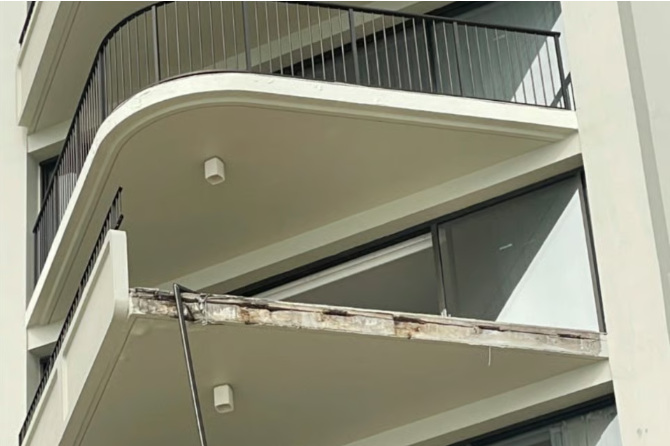
National Building Expert Urges Inspections After Waikiki Hotel Railing Collapse
Lance Luke, a building safety expert, emphasizes the need for routine inspections and maintenance to prevent structural failures, like the recent hotel railing collapse. He advocates for increased awareness and proactive measures to ensure building integrity and safety.
Honolulu, United States - February 21, 2024 —
In light of a recent incident involving the collapse of a hotel railing, Lance Luke, a renowned national building expert, emphasized the critical need for regular building inspections and increased awareness among hotel guests, and apartment and condo building residents regarding potential safety hazards. Luke's insights were shared during several news interviews, shedding light on the often-overlooked dangers posed by environmental conditions to building structures.
Lance Luke, with over four decades of experience in the construction industry, highlighted the phenomenon of spalling, a condition where water ingress leads to the expansion and rusting of reinforcing steel (rebar) within concrete structures, ultimately causing cracks and potential collapse. This condition, exacerbated by environmental factors such as humidity, salt air, and rainfall, particularly affects coastal and island locations where buildings are frequently exposed to harsh marine environments.
The discussion followed an incident where a section of railing at a hotel situated on the beachfront collapsed, thankfully without resulting in injuries or fatalities. This event served as a stark reminder of the latent risks present in aging structures exposed to corrosive elements. Luke pointed out that the process of spalling and corrosion does not occur overnight but is the result of years of neglect, with estimates suggesting a timeline of ten to fifteen years for such deterioration to become critical.
Luke, the principal consultant at Construction Management Inspection, LLC, stressed the importance of preventive maintenance and regular inspections to identify early signs of wear and tear. He noted that while many buildings lack a comprehensive inspection regimen, it is imperative for property managers and owners to implement routine checks for indicators of potential structural failure, such as peeling and bubbling paint, rust stains, and cracks on concrete at the base of railing posts.
Moreover, Luke called for the engagement of independent structural engineering firms for thorough investigations at regular intervals, advocating for a shift towards proactive rather than reactive maintenance strategies. He underscored the necessity of destructive and load testing in certain cases to assess the integrity of critical structural components, albeit acknowledging the associated costs and logistical challenges, particularly in high-rise buildings.
The conversation also touched upon the financial implications of necessary repairs and safety measures, with Luke indicating that the costs could run into millions of dollars. However, he argued that such expenditures are justified when considering the alternative risks to human life and property.
To further educate the public and industry professionals, Luke mentioned his initiative of conducting free webinars through his platform, "Ask the Building Expert." These sessions aim to raise awareness about building safety, maintenance best practices, and the latest industry standards to prevent similar incidents in the future.
In conclusion, Lance Luke's insights from the interview highlight the critical importance of vigilance, regular inspections, and maintenance to safeguard the safety and integrity of buildings. As the industry progresses, a blend of expert knowledge, public awareness, and regulatory oversight will be essential in preventing future tragedies and maintaining the structural health of the built environment.
For more information, visit https://askbuildingexpert.com/ to access resources, webinar schedules, and expert advice on building safety and maintenance.
Contact Info:
Name: Lance Luke
Email: lanceluke@hawaiibuildingexpert.com
Organization: Construction Management Inspection LLC
Address: 820 W. Hind Drive, Suite 240275, Honolulu, HI 96824
Phone: (808)-422-2132
Website: http://railingexpert.hawaiibuildingexpert.com
Contact Info:
Name: Lance Luke
Email: Send Email
Organization: Construction Management Inspection LLC
Address: 820 West Hind Drive Suite 240275, Honolulu, HI 96824, United States
Phone: +1-808-754-3425
Website: https://hawaiibuildingexpert.com/
Source: PressCable
Link of the article: National Building Expert Urges Inspections After Waikiki Hotel Railing Collapse

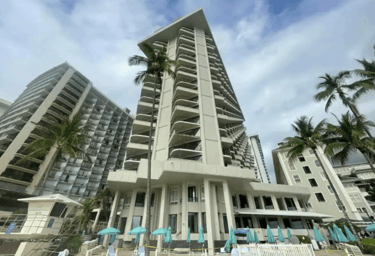
Railing falls off popular Hawaii hotel, lands on Waikiki beach
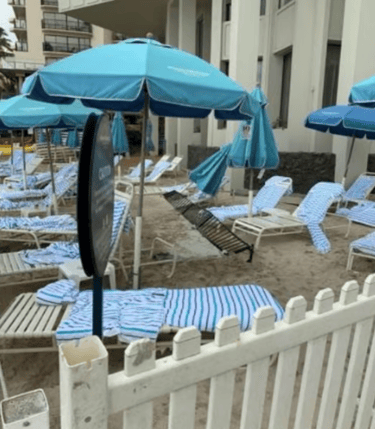
On Jan. 30, around 1 p.m., a railing fell off a hotel balcony on the fifth floor at the Moana Surfrider in Waikiki, Hawaii, nearly missing a passerby before it fell onto the beach.
“When I went to the bedroom balcony and looked down, I saw where it landed, and I thought ‘Thank God’ because two feet either way it probably would have killed somebody,” a guest told Hawaii News Now.
The railing didn’t directly hit anyone, the Honolulu Fire Department told Hawaii News Now, but one person was treated for minor injuries by Ocean Safety, and “Another person suffered a minor injury while escaping the falling railing.” Two people refused transport to the hospital, Emergency Medical Services told Hawaii News Now.
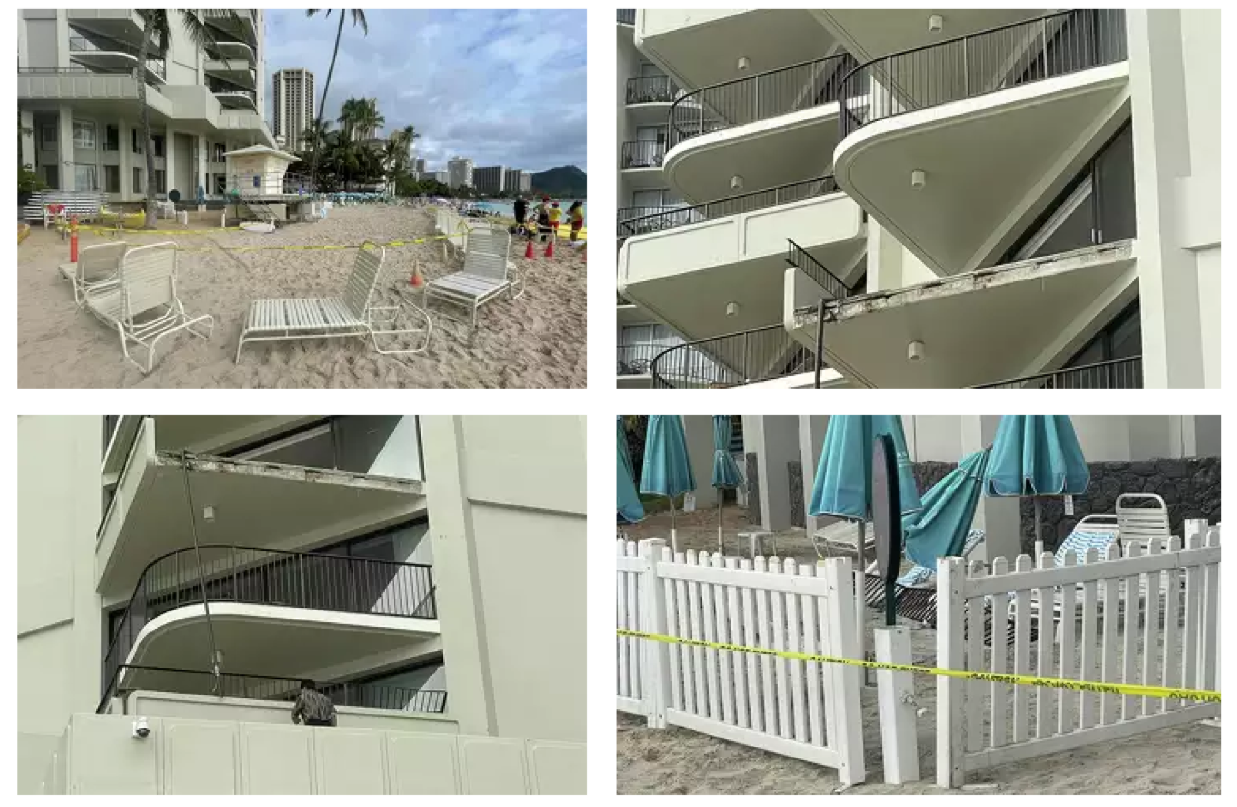
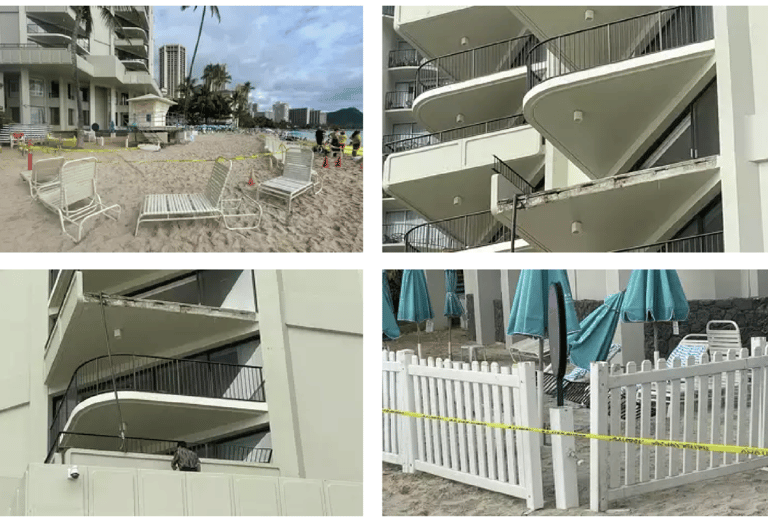
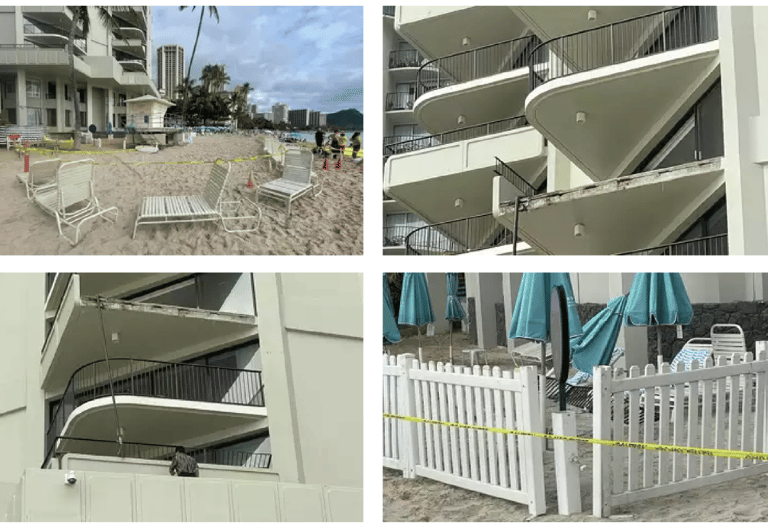
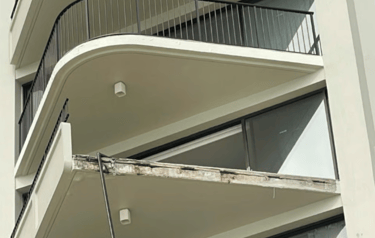
The Honolulu hotel caution-taped off a portion of the beach. It’s unclear what detached the railing. Lance Luke, a construction engineer, took photos of the fallen railing. He said corrosion was likely the problem.
“I could see horizontal rebar that was pretty corroded,” Luke told KHON2. “So I’m pretty sure that this is not the only unit like that.”
In a statement from the Moana Surfrider to Hawaii News Now, Dara Young, director of public relations for the Waikiki Collection, said the hotel is “looking into an incident that occurred involving a balcony in our Tower Wing. We take this matter very seriously.”
Waikiki Beach in Hawaii’s capital city is an extremely popular tourist attraction, generating 41% of the state’s tourism revenue in 2015.
By: Olivia Harden
Jan 31, 2024
Source: SFGate
Link of the article: Railing falls off popular Hawaii hotel, lands on Waikiki beach
Check Your Building's Lanai Railings- STAT!
Last month there was a railing collapse at the Moana Surfrider Westin Resort on world-famous Waikiki Beach. A fifth-floor hotel room railing wall constructed of a solid concrete plank gave way and fell to the beach below. No one was on the lanai when it occurred and no one was hurt on the beach — but a woman on a lounge chair was nearly struck.
Upon inspection, I noticed that numerous anchor bolts that connected the railing wall to the balcony floor were corroded, and the floor tile and concrete topping delaminating from the concrete slab had bubbled paint on its underside. My initial thought was the floor tile grout was cracked, damaged or unsealed, causing water to penetrate into the concrete slab causing spalling. The waterproofing may have failed. The metal anchors securing the wall to the floor had severely corroded and provided no structural support at any anchor points.
This is a wake-up call to all building owners and managers to inspect and maintain railings. inspection programs should include apartment and condo structures, hotels, office buildings, shopping centers, etc. Every building owner and manager should mandate periodic inspections. Currently, there is no mandated inspection of buildings by the city, state, or federal government.
Spalling occurs when water penetrates unprotected concrete and causes corrosion of the reinforcing steel — rebar — embedded in the concrete. The corrosion of the rebar causes it to expand, ultimately causing cracks and potential collapse of the affected area. Humidity, salt air, rainfall, trade winds and sun contribute to spalling, which in turn affect buildings in coastal lo cations and exposed to harsh marine environments.
The hotel railing collapse serves as a stark reminder of the latent risks present in aging structures exposed to corrosive elements. Corrosion and spalling is the result of years of neglect and substandard and/or no repair and maintenance. Costs to repair can reach
millions of dollars.
A comprehensive building inspection program should be implemented to spot potential structural failures.
Red flags include signs of peeling or bubbling paint, rust stains and cracks on concrete surfaces, pieces of concrete falling off a building, or cracks and/or corrosion at railing post bases.
Best practices include thorough inspections at regular intervals and repairs of observed substandard conditions. It is better to be proactive rather than reactive. The next step would be destructive testing after a visual spalling-condition survey.
In 2016, a third-floor railing collapsed at Ala Moana Shopping Center, resulting in one person killed and another seriously injured. After the incident, the City and County of Honolulu Department of Planning and Permitting issued a Notice of Violation for metal railing
corrosion and concrete spalling. Required repairs cost the center more than $4 million.
This tragic incident prompted Honolulu City Council to propose legislation for mandatory structural building inspections. Unfortunately, the legislation did not pass. Heavy pushback came from building owners, property managers and condo boards who feared extra costs.
Once again, City Council is currently discussing a mandatory building inspection program.
Let’s not forget the Surfside, Fla., condominium building collapse in 2021 that killed 98 people. Surfside, a Miami suburb, required only a 40-year building recertification program then. This did not make any sense due to numerous spalling conditions that are expected to occur at the 15- to 20-year life cycle of a building. In Hawai‘i, there is no mandated governmental building inspection program at all.
All building owners and property managers should be proactive and start inspection programs now.
Apartment buildings, low- and high-rise condominiums, hotels, shopping centers, office buildings, etc., all
need to be inspected.
Lance Luke owns Construction Management Inspection LLC.
lanceluke@hawaiibuildingexpert.com,
hawaiibuildingexpert.com, http://railingexpert.hawaiibuildinfexpert.com/